Design & History
The story behind America's most beautiful coin design, from the 1907 $20 Gold Piece to the modern bullion program.
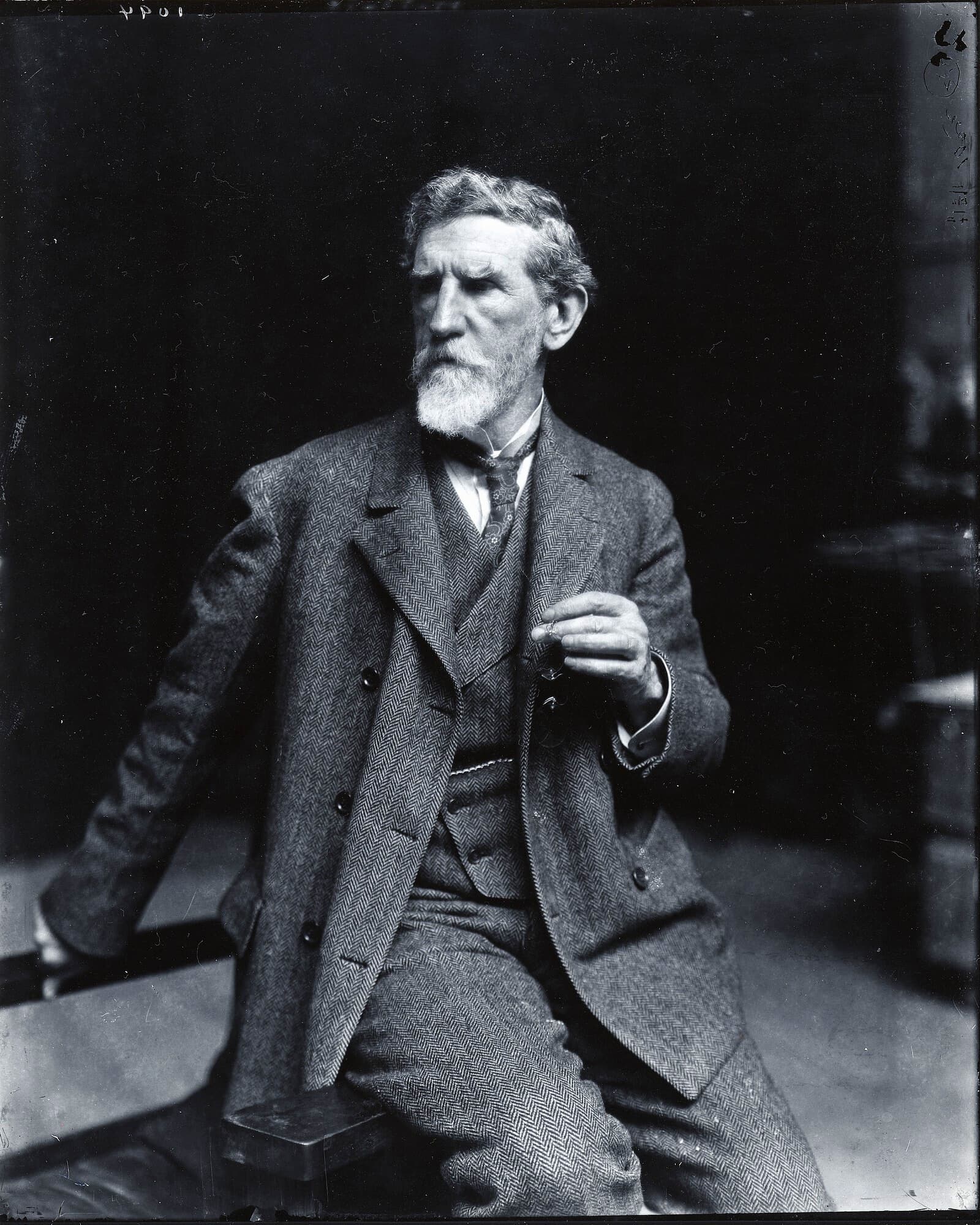
Augustus Saint-Gaudens (1848-1907)
Augustus Saint-Gaudens is considered one of the foremost American sculptors. Born in Dublin, Ireland, and raised in New York City, he trained at the Cooper Union, the National Academy of Design, and the École des Beaux-Arts in Paris.
Major works include the Robert Gould Shaw Memorial (Boston), the General William Tecumseh Sherman Monument (New York), and the Adams Memorial (Washington, D.C.).
In 1905, President Theodore Roosevelt commissioned Saint-Gaudens to redesign American gold coinage. The resulting $10 and $20 gold pieces (1907) are widely regarded as among the most beautiful coins ever minted. Saint-Gaudens died in August 1907, shortly after the designs entered production.
Obverse: Walking Liberty
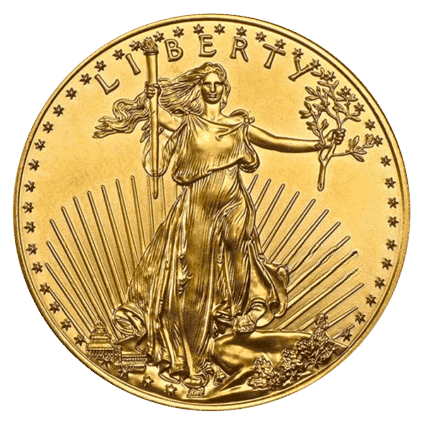
The obverse features Saint-Gaudens' Walking Liberty design, originally created for the 1907 $20 gold piece. Lady Liberty strides forward, holding a torch in her right hand and an olive branch in her left. Rays of sunlight radiate from behind the Capitol building.
Design elements:
- •Torch: Symbolizes enlightenment and freedom
- •Olive branch: Represents peace
- •Stars: Thirteen stars for the original colonies
Inscriptions include “LIBERTY” and the year of minting.
Reverse: Eagle Family
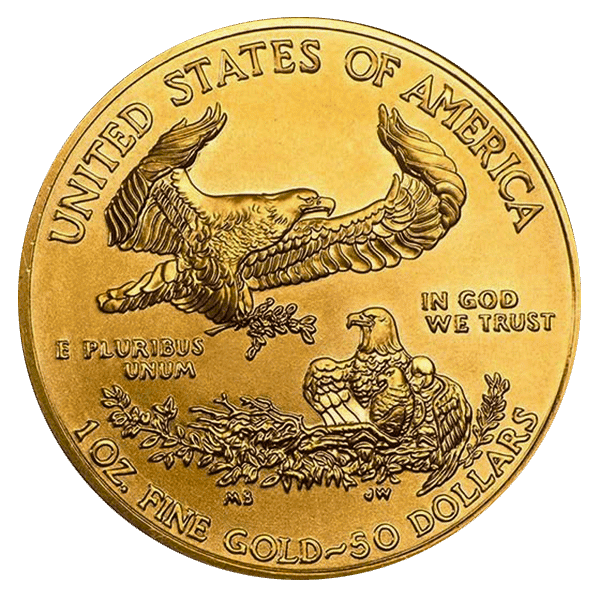
The original reverse (1986-2021), designed by sculptor Miley Busiek, depicts a male eagle carrying an olive branch, flying above a nest containing a female eagle and hatchlings.
Design elements:
- •Male eagle: Carrying an olive branch, symbolizing provision
- •Nest: Female eagle with hatchlings, representing family
- •Olive branch: Symbol of peace
Inscriptions: “UNITED STATES OF AMERICA,” “E PLURIBUS UNUM,” “IN GOD WE TRUST,” face value, and weight/purity.
2021 Update: The U.S. Mint introduced a refreshed reverse design by Jennie Norris, featuring a close-up portrait of a single eagle.
Roosevelt's Coinage Reform
Theodore Roosevelt initiated the redesign of American gold coinage, citing ancient Greek coins as the standard for numismatic art. He believed American coins should reflect the nation's stature.
The original Saint-Gaudens $20 gold piece (1907-1933) featured a high-relief design. The relief was later reduced for practical mass production. These coins circulated until Executive Order 6102 ended gold coinage in 1933.
“I think the state of our coinage is artistically of atrocious hideousness. Would it be possible, without asking permission of Congress, to employ a man like Saint-Gaudens to give us a coinage which would have some beauty?”
Theodore Roosevelt, 1905
When the U.S. Mint established its modern bullion program in 1986, the Saint-Gaudens Liberty design was selected for the Gold Eagle, connecting contemporary bullion to this numismatic heritage.
The Modern Bullion Program
The American Gold Eagle was authorized by the Gold Bullion Coin Act of 1985 and first minted in 1986. It was created to provide American investors with a domestic alternative to foreign bullion coins like the South African Krugerrand.
1986 Launch
America's flagship gold bullion coin debuted, reviving Saint-Gaudens' masterpiece for modern investors.
Multiple Sizes
Available in 1 oz, 1/2 oz, 1/4 oz, and 1/10 oz sizes to accommodate different investment levels.
West Point Mint
Gold Eagles are primarily struck at the West Point Mint in New York, one of the U.S. Mint's four production facilities.
Ongoing Production
Minted annually since 1986, the Gold Eagle remains the cornerstone of the U.S. Mint's bullion program.
Learn more about the Gold Eagle's history at Monex Knowledge Base
What the Design Signals to Investors
For investors, the design conveys more than visual appeal:
American Heritage
The Saint-Gaudens design connects to over a century of American numismatic tradition. Investors recognize the design instantly, a factor that supports liquidity and trust.
Government Authority
The design's official U.S. Mint provenance signals authenticity and weight/purity guarantees backed by the federal government.
Timeless Value
Saint-Gaudens' 1907 design has endured for over a century. Its continued use on modern bullion suggests permanence, a quality investors seek in store-of-value assets.
Global Recognition
The Gold Eagle design is recognized by dealers and investors worldwide, facilitating transactions across borders and markets.
Collector Crossover
The design's artistic merit appeals to both bullion investors and numismatists, potentially broadening the buyer pool when selling.
Eagle vs. Buffalo: Design Philosophy
The U.S. Mint produces two gold bullion coins with distinct design philosophies:
Gold Eagle
- • Augustus Saint-Gaudens' 1907 Liberty design
- • Walking Liberty and eagle family imagery
- • Symbolizes freedom and national ideals
- • Classic patriotic aesthetic
- • America's flagship bullion coin since 1986
Gold Buffalo
- • James Earle Fraser's 1913 Buffalo Nickel design
- • Native American and bison imagery
- • Celebrates American frontier heritage
- • Artistic, collectible aesthetic
- • U.S. Mint's 24-karat option since 2006
Compare Eagle and Buffalo coins in detail at Monex: Gold Eagle Guide
Key Dates in Gold Eagle Design History
Augustus Saint-Gaudens born in Dublin, Ireland
President Theodore Roosevelt commissions Saint-Gaudens to redesign American coinage
Saint-Gaudens $20 gold piece enters circulation; Saint-Gaudens passes away
U.S. gold coinage ends under Executive Order 6102
Gold Bullion Coin Act authorizes the American Gold Eagle program
First American Gold Eagle coins minted with Saint-Gaudens obverse
U.S. Mint introduces updated reverse design
Gold Eagle remains America's most popular gold bullion coin
Related pages